bronze objects in the Strassacker Edition
A wide range of organic materials such as millet, rice, seeds, plant fragments, and other natural substances were used in the creation of the surface structures. These materials are integrated into the modeling process and leave their distinctive traces on the surface. The structures do not emerge as decorative elements but develop through a direct dialogue with the material itself. Every seed, every grain, and every organic form possesses its own geometry and individual rhythm. Through their multiplication, complex surfaces arise that evoke natural growth processes or geological formations.
The sculpture Taurus draws on the symbolism of the bull, which played a prominent role in many ancient cultures. In Minoan Crete in particular, the bull was a central religious and cultural symbol. In Greek mythology as well, the bull repeatedly appears as a powerful being associated with fertility, strength, and divine force. One of the most well-known figures within this mythological context is the Minotaur - this mysterious creature with the body of a human and the head of a bull, who lived in the labyrinth of Knossos. The Minotaur embodies the union of the human and the animal, of consciousness and the unconscious, of order and chaos. Taurus is not intended as a direct depiction of a bull, but rather as a free sculptural interpretation of the meanings associated with it. The work stands for strength, courage, and inner resilience. It connects archaic knowledge with a contemporary formal language, thereby creating a bridge between past and present.
The sculpture Hix engages with questions of origin and emergence. The title refers to the so-called “God particle,” the Higgs boson, whose experimental confirmation at the beginning of the 21st century was celebrated as a major scientific milestone. This discovery opened new insights into the structure of matter and the conditions that make the universe possible in the first place. At the same time, the “X” in the title alludes to the X chromosome, which plays a central role in the biological transmission of life. Thus, the work connects different notions of origin: the physical search for the fundamental building blocks of the universe and the biological basis of life.
The surface structure of Hix was created through the use of rice grains in combination with a cellulose mass. During the modeling process, the individual grains formed a dense network of depressions and elevations. The resulting structure generates a multilayered surface that oscillates between natural growth and scientific association.
Both Taurus and Hix highlight an interest in the transitions between archaic knowledge and contemporary thought, between observation of nature and cultural memory. Through the combination of organic surfaces, symbolic references, and abstract form, these objects emerge that connect both ancient narratives and current questions, inviting the viewer to develop their own associations.
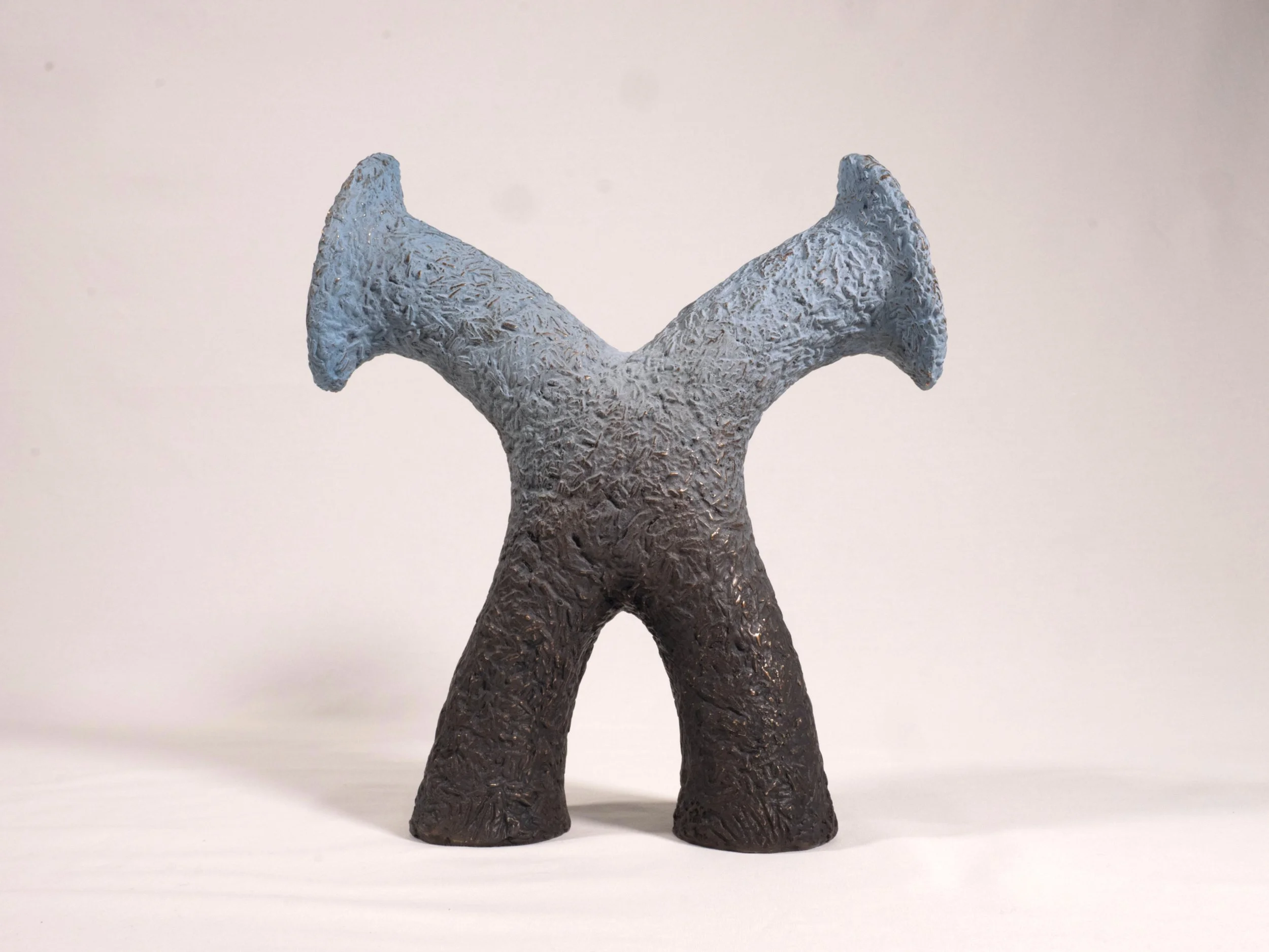
hix (Edition Strassacker), bronze, 30x27x7,50 cm, 2025, image: Heiko Nowack
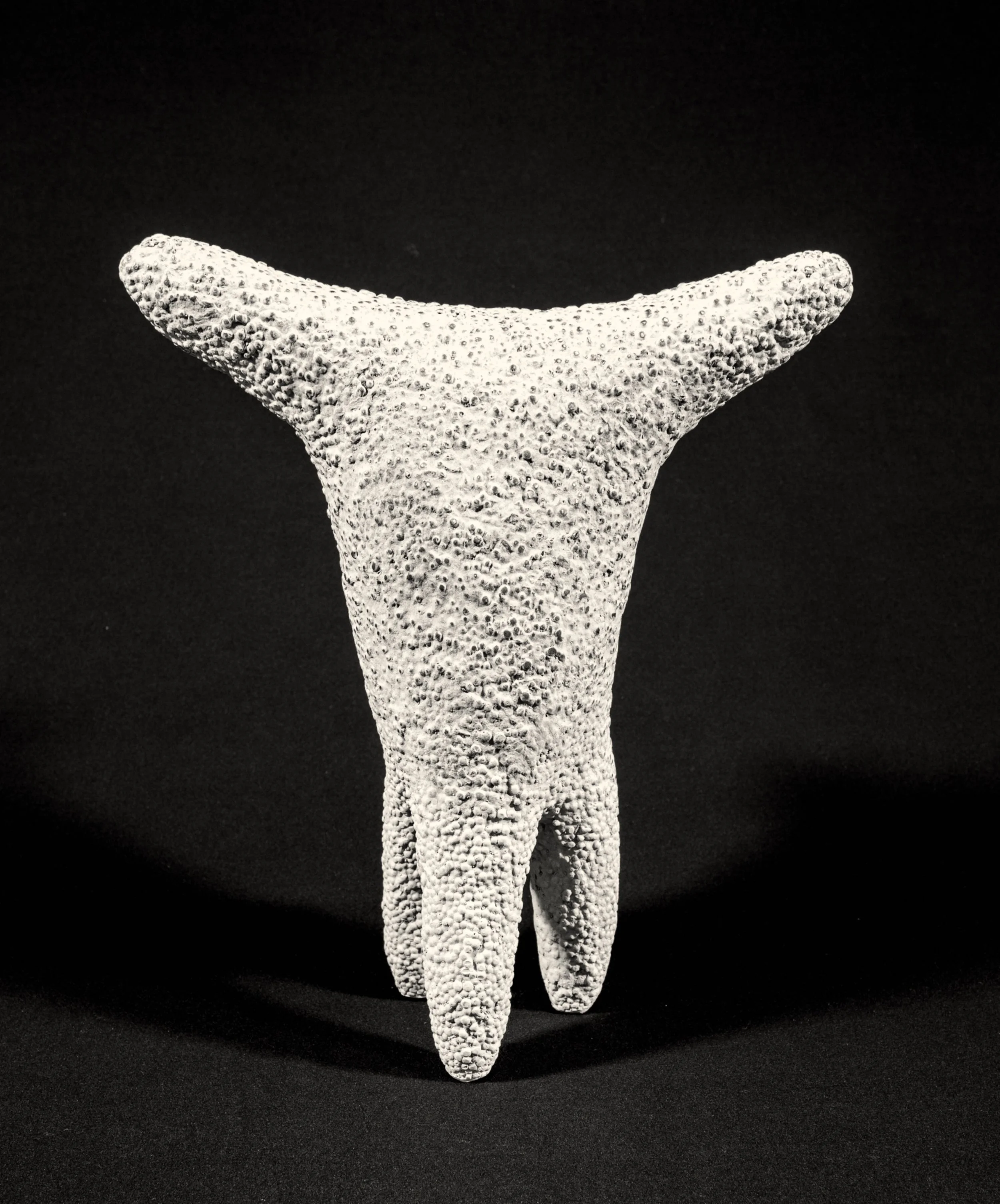
taurus (Edition Strassacker), bronze, 29x25x25 cm, 2025, image: Heiko Nowack